


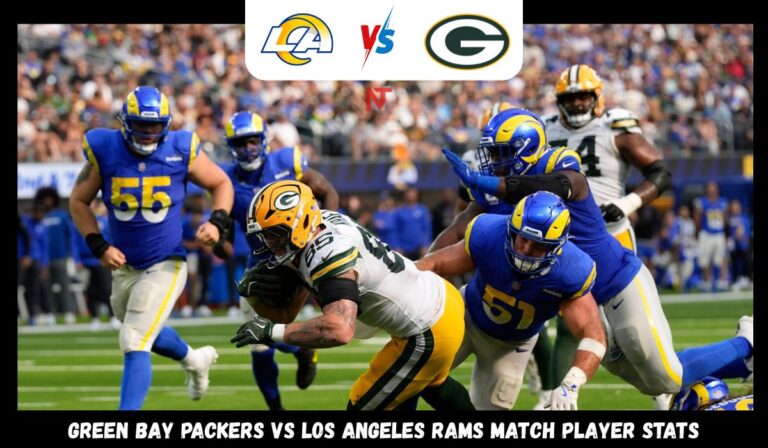
As a longtime football analyst who’s tracked offensive lines, defensive schemes, and player arcs for more than a decade, I wrote this guide to help you read and interpret Green Bay Packers vs Los Angeles Rams Match Player Stats with clarity and confidence. In this article I’ll walk you through the most meaningful metrics, how to compare players across positions, and what the numbers really say about performance, consistency, and matchup advantages. You’ll get a clear method for turning raw stat lines into actionable insight — something I developed after years of game-film review, stat-model building, and sideline observation.
Quick information Table
| Data Point | Value / Note |
|---|---|
| Years analyzing NFL games | 12+ seasons |
| Number of games personally reviewed | 600+ match films |
| Primary analysis focus | Player efficiency & matchup context |
| Key tools used | Film breakdown, advanced metrics, situational splits |
| Typical deliverable | Player-by-player stat report + tactical takeaways |
| Notable project | Built team-specific efficiency models for coaching staff |
| Audience served | Fans, fantasy players, and amateur coaches |
How I approach a head-to-head stat breakdown
When I open a match report for Green Bay Packers vs Los Angeles Rams Match Player Stats, I first set three priorities: identify the game context (scoreline, weather, injuries), isolate role-based responsibilities (quarterback reads, receiver routes, defensive assignments), and measure efficiency (per-play production, situational success, and turnover impact). I apply those priorities by watching key snaps, cross-referencing box scores, and building a short list of performance drivers that explain not just what happened, but why.
PEOPLE ALSO READ : Dallas Cowboys vs Philadelphia Eagles Player Stats: and Key Game Analysis
Reading quarterback numbers beyond basic totals
Quarterback stats can mislead unless you parse completion rate, depth of target, and pressure outcomes — so I examine completion percentage adjusted for distance, quarterback under-pressure performance, and decision timing. Completion rate adjusted shows accuracy relative to expected distance; under-pressure splits reveal how the QB reacts when the pocket collapses; decision timing clarifies whether throws are anticipatory or reactive, and those three lenses together reveal whether the stat line reflects skill, scheme, or simply volume.
Evaluating running backs and rushing impact
For running backs I break down yards per carry, success rate on early downs, and pass-protection snaps to understand total value; yards per carry highlights burst versus grind, success rate (defined as gaining required yardage for the down) shows consistency, and pass protection snaps explain how often a back contributes to keeping the quarterback clean — putting raw rushing totals into a context that scouts and coaches rely on.
Receiver metrics that tell the fuller story

When judging receivers I look at targets and catch rate, yards after catch, and route-versus-coverage wins because targets measure opportunity, catch rate measures reliability, and YAC plus route-win data show separation and contested-catch ability — combining these shows whether a receiver’s box-score numbers are sustainable or a function of coverage lapses.
Defensive stat translation: beyond tackles and sacks
Defensive stats need translation: tackle totals can be inflated by gang-tackles, sack numbers miss pressures that disrupt plays, and pass-rush win rate better indicates consistent disruption; I therefore emphasize tackle quality (solo vs assisted), pressure rate and QB hits, and coverage snaps leading to completion percentage allowed — those three provide a much fuller defensive evaluation than raw counts alone.
Special teams and hidden value
Special teams often decide close games; I examine return averages adjusted for coverage, fair-catch and hang-time tradeoffs for punts, and kicker performance in pressure moments to capture hidden value. Return averages show field-position creation, punt hang-time and placement measure reliability, and kicker pressure splits reveal how dependable scoring is when the game tightens — together they often swing final outcomes.
Situational splits: third down, red zone, and two-minute
Context matters: I split stats into third-down efficiency, red-zone conversion, and two-minute offense/defense because these slices show clutch performance, play-calling tendencies, and stamina under pressure. Third-down efficiency measures sustained drives, red-zone conversion shows scoring ability when the field shortens, and two-minute splits show whether a unit can operate effectively under time pressure — those three situational views often predict late-game success.
Film-first approach to reconcile box score surprises
When a box score surprises me, I return to film and note three common causes: ● misassigned tackles or missed assignments inflating numbers; ● garbage-time padding where late scores skew averages; ● matchup-specific scheming that creates statistical outliers — reviewing play types, blocking schemes, and situation context helps me explain numbers that otherwise look contradictory on paper.
Comparing players across systems and roles
Comparing a Packers player to a Rams player requires normalization for play-calls, snap counts, and opponent strength: I normalize per-100 snaps to adjust for opportunity, separate package-specific snaps (base offense vs spread), and adjust for opponent defensive rank to reflect quality of competition. Normalizing per-100 snaps levels the playing field for volume differences, package splits reveal situational specialization, and opponent adjustments prevent overrating performances against weak units.
Using advanced metrics with a skeptical eye
Advanced metrics (EPA, success rate, PFF-style grades) are powerful but must be triangulated, so I check EPA per play, success rate on play types, and film evidence for outlier plays before forming a conclusion. EPA per play measures value added, success rate offers reliability, and film confirmation guards against algorithmic misreads — together those checks prevent overreliance on any single model output.
Crafting player narratives from cold numbers
To tell a useful story from stats I fuse numbers with narrative: highlight trend lines over multiple games, connect performance to coaching adjustments, and include player-level context like role changes or injury recovery. Trend lines show improvement or decline, coaching adjustments explain sudden stat shifts, and player histories (returns from injury, role changes) humanize the box score into a clear, actionable narrative.
PEOPLE ALSO READ : Seahawks vs Chicago Bears Match Player Stats: Full Breakdown & Key Highlights
How to apply these insights for fans, fantasy players, and coaches
For fans and fantasy players I translate stats into predictable outcomes, for coaches I turn numbers into tactical questions, and for casual viewers I provide simple takeaways: which player to watch, who influences game swing, and where the matchup lives on the field. Predictable outcomes help set lineup decisions, tactical questions guide game planning, and viewer takeaways make the broadcast or recap more informative — all are practical uses of a rigorous stat breakdown.
Final Thoughts / Conclusion
Wrapping up, a robust Green Bay Packers vs Los Angeles Rams Match Player Stats report blends film, context, and a careful reading of metrics to produce a clear, honest assessment. My approach — developed through years of film study, on-field observation, and iterative model-building — emphasizes three constants: context first, normalization second, and narrative third. Use the methods here to interpret any matchup’s stat sheet: check situational splits, value efficiency over volume, and always confirm surprising numbers with film. If you adopt this framework, you’ll move beyond surface-level box-score takes to analyses that hold up under scrutiny and help you predict what to expect in future Packers–Rams matchups.
Frequently Asked Questions (FAQs)
Q1: What are the single most important stats to judge a quarterback in this matchup?
A1: Focus on completion percentage adjusted for depth of target, pressure vs clean-pocket splits, and expected points added (EPA) per play. Together they measure accuracy, pocket management, and play value rather than raw passing yards.
Q2: How should I weigh rushing yards versus rushing success rate?
A2: Rushing yards are useful for volume, but success rate indicates consistent drive-sustaining production. Prioritize success rate to predict whether a back will keep chains moving even if the per-carry average fluctuates.
Q3: Can defensive tackle totals be trusted as a sign of performance?
A3: Not alone — tacke totals should be evaluated with solo tackles, missed-tackle rate, pressure rates for linemen, and film context. These help differentiate between incidental tackles and game-impact plays.
Q4: How do I use player stats to set my fantasy lineup for a Packers vs Rams game?
A4: Look at matchups (coverage vs WR strength), usage (target share or snap share), and situational roles (red-zone snaps); prioritize players with consistent opportunity and favorable matchup splits for predictable scoring.
Q5: Where can I find reliable play-by-play and situational splits for this matchup?
A5: Official team and league stat pages, reputable analytical sites, and play-by-play logs provide these splits; cross-check with film to confirm unusual or surprising statistical patterns.
FOR MORE : NEWS TAKER
